
Other Initiatives
Kapilas Cement Plant, Cuttack
Green Mobility Promotion – Green Supply Chain
As India’s pioneer in green and clean manufacturing, we are making concrete efforts to introduce innovative solutions that promote sustainable transport as well as increase the decarbonisation of our fleet.
By walking the green path, we intend to pave the way for smarter transport that not only optimises energy use but also ensures supply chain sustainability.
The positive implications that our green mobility initiatives will have, especially in environmental, economic and social terms, are encouraging. Our EV fleet will help lower health risks in and around the areas we operate in and promote optimal use of water resources.
This renewable energy integration will also lead to positive climate action by reducing pollution.
As early adopters, we see this transition as a step forward towards building a nation powered by resilience and self-dependence.
Utilising Innovative Solutions such as Carbon Capture and Utilisation (CCU)
Of the cumulative carbon emissions in the cement industry, ~55% are attributable to the de-carbonation of limestone in the process.
These emissions can only be eliminated through a technology lever called “carbon capture and utilisation.”
While there have been global experiments in carbon capture and utilisation, in India this is still at a nascent stage.
As a first step at Dalmia Bharat, we completed the feasibility study of a large-scale Carbon Capture and Utilisation (CCU) plant in India with support from the Asian Development Bank (ADB), Tamil Nadu.
We are actively advancing the adoption of new decarbonisation technologies to drive significant emission reduction in the cement industry. As part of our commitment to Carbon Capture and Utilisation (CCU), we are working with IIT Bombay to set up a CCU test bed at one of our plants. This initiative has been shortlisted and was discussed at a meeting with the Department of Science and Technology (DST), Government of India, on February 25. This marks an important step towards scaling up CCU technology to address process emissions. Through these efforts, we are reinforcing our role as leaders in pioneering climate-friendly innovations and speeding up the industry’s transition to net-zero emissions.
Reducing our GHG Footprint
As leaders in sustainability, we have been very successful in adding to our capacity while reducing our Greenhouse Gas (GHG) footprint.
We plan to further explore the use of biomass as a fuel to completely replace fossil fuels in the manufacturing process.
We have also started using biodiesel in our mining operations, and this has largely contributed to our efforts to reduce GHG emissions from liquid fossil fuels consumed in mining equipment, heavy vehicles and as a start-up fuel in cement operations.
Continuous Emission Monitoring Systems (CEMS)
Central to the production process of cement is the decarbonisation of limestone, and this eventually leads to the release of a large amount of carbon dioxide.
We have therefore set up Continuous Emission Monitoring Systems (CEMS) at our manufacturing units across the country to provide real-time emission status.
We see this as providing a huge advantage to our operations, as by measuring real-time emissions we are not only ensuring compliance but also enhancing the operational excellence of our units.
In addition, we have also set up Ambient Air Quality Monitoring Systems (AAQMS) to monitor and display results so as to apprise local stakeholders on a regular basis.


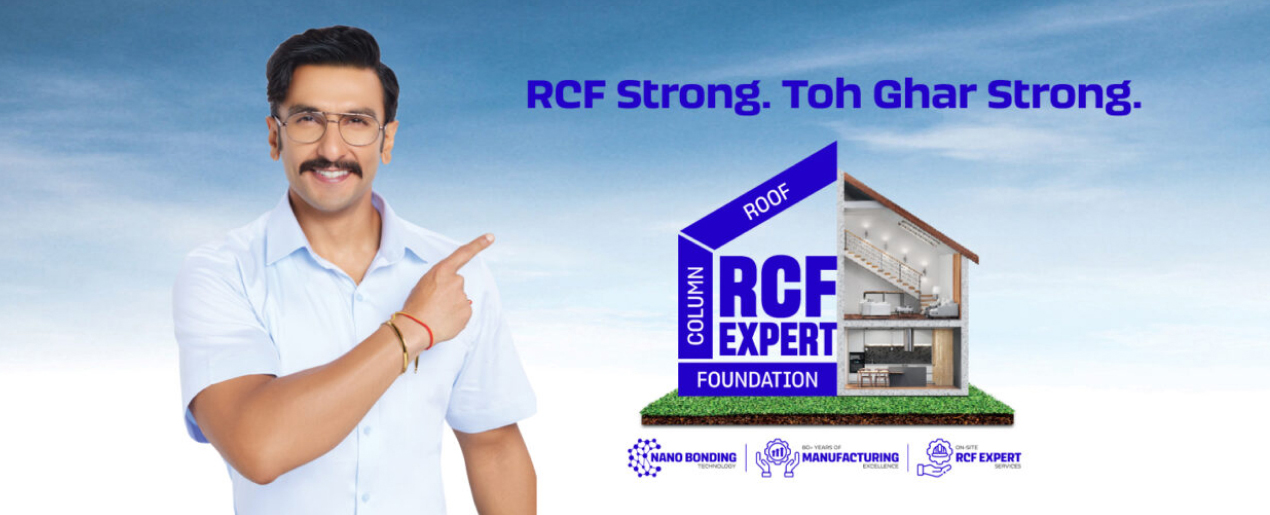
What Is RCF?
RCF stands for Roof, Column, and Foundation and is the core structural system of any building, responsible for overall stability and load-bearing capacity. Therefore, RCF Strong. Toh Ghar Strong.