Integrated Annual Report2025-26

Prioritising Issues that
Deliver Meaningful Value

We advanced our sustainability agenda through a rigorous double materiality assessment in FY 2024-25, sharpening strategic focus and strengthening long-term preparedness. The exercise enhanced enterprise resilience, refined capital allocation, and reinforced our ability to create sustained stakeholder value.

Materiality Assessment: Approach and Methodology

Our double materiality process integrates financial and impact perspectives to deliver a structured, decision-oriented evaluation. It examines how the Company’s operations and strategic direction influence the environment and society, while also assessing how external sustainability factors shape financial performance. Insights were informed through extensive engagement with both internal and external stakeholders, including employees, customers, and industry experts.

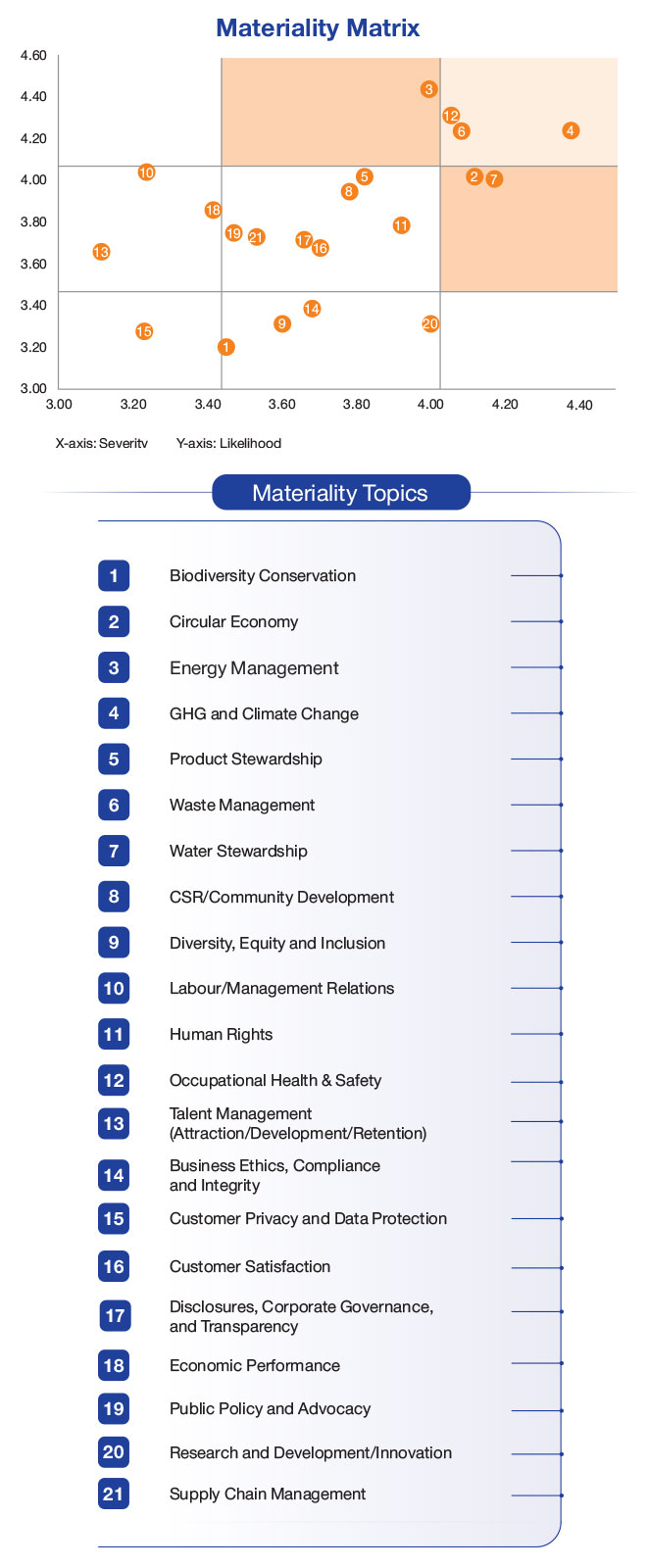
An initial set of 21 material topics was identified through a combination of sector benchmarking, global standards and frameworks, and in-depth secondary research. These topics span Environmental, Social, and Governance dimensions, reflecting priorities relevant to our business and the wider cement and construction landscape.

Prioritisation and Ranking of Material Topics

Stakeholders evaluated each topic based on perceived importance and relevance. Every topic was assessed across two dimensions: the likelihood of occurrence and the magnitude of potential impact. Scores were then synthesised using a structured methodology, applying a Risk Priority Number (RPN) to ensure analytical rigour. A calibration process was introduced to standardise scoring across inputs, improving comparability and consistency.

Outcomes of the Materiality Assessment

The assessment resulted in a prioritised set of material topics, clearly identifying the issues most critical to our sustainability strategy, risk management, and disclosures. By embedding stakeholder expectations and regulatory considerations, the process ensures our strategic focus remains aligned with both external demands and long-term value creation. It anchors disciplined decision-making and positions the organisation to deliver durable growth with measurable impact.

Materiality Matrix

Materiality Topics

  • 1

    Biodiversity Conservation

  • 2

    Circular Economy

  • 3

    Energy Management

  • 4

    GHG and Climate Change

  • 5

    Product Stewardship

  • 6

    Waste Management

  • 7

    Water Stewardship

  • 8

    CSR/Community Development

  • 9

    Diversity, Equity and Inclusion

  • 10

    Labour/Management Relations

  • 11

    Human Rights

  • 12

    Occupational Health & Safety

  • 13

    Talent Management (Attraction/Development/Retention)

  • 14

    Business Ethics, Compliance and Integrity

  • 15

    Customer Privacy and Data Protection

  • 16

    Customer Satisfaction

  • 17

    Disclosures, Corporate Governance, and Transparency

  • 18

    Economic Performance

  • 19

    Public Policy and Advocacy

  • 20

    Research and Development/Innovation

  • 21

    Supply Chain Management